Saturday, May 28, 2011


Sunday, April 24, 2011
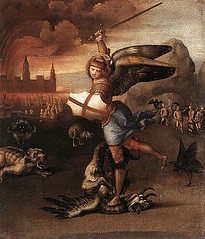
Santiago Matamoros - the Moor (Muslim) slayer
 The finding of the sacred remains of St. James, the Son of Thunder, by Bishop Teodomirus signalled the general call to war against the Moorish (Islamic) invaders, who had by then the control of the greatest part of the Peninsula, the Northwest excepted, and had even entered into France, menacing the rest of Christendom. A small militia under King Don Pelayo had already repelled the invaders at the battle of Covadonga, in 718, starting the Reconquista of Spain.
It was at Clavijo, in 845, that the forces of King Ramiro I defeated the far superior army of Abderraman II. The galvanizing cry of the Christian soldiers was ¡Santiago y cierra España!, "For St. James, and close ranks, Spain!" The General Chronicle of King Alfonso X the Wise reports a miraculous event during the battle of Clavijo, which gave the cult of St. James a dramatic configuration. According to witnesses, Santiago was seen descending from the sky mounted on a white horse, having in one hand a snow-white banner on which was displayed a blood red cross, and in the other a sword, en un cavallo blanco con una senya blanca et grand espada reluzient en la mano. We may interpret this intervention of St. James as a precise fact or as a poetic licence; what matters is the undeniable fact of the miraculous protection of the Son of Thunder, who will become from this time on the Patron of Spain. The imagery will present him thereafter as a knight on a white horse, carrying a banner with the Cross of Santiago and wielding a flashing sword. Protector of Christendom, he became Santiago Matamoros, the Moor slayer. And the Mozarabic Office salutes him from then on as Defensor Almae Hispaniae, Jacobe, vindex hostium, "James, defender of the soul of Spain, punisher of its enemies."
If Islam was able to subjugate the Visigothic monarchy with the help of the Prophet Mohammed, the small Christian troops will counterattack with the assistance of St. James. As Américo Castro put it, Cruzadas versus Alcoranadas, or the Cross against the Koran.
The vocation of the Son of Thunder for combat against the infidels manifested itself in countless occasions during the Reconquista and every war in defence of Holy Religion, up to our days. Caudillo de Cruzados, "commander of crusaders," he was invoked by the soldiers fighting the Reds during the Spanish civil war (1936-1939) and especially during the decisive battle of the river Ebro. Generalissimo Francisco Franco went as far as stating: "If one wants to get rid of Spain, take away Santiago."
Santiago Matamoros, in the words of Félix Sardá y Salvany, the great Catalan anti-Liberal apologist, "is the most perfect and adequate representation of the faith of our people; the faith of Spain is indeed a militant faith; this is what has characterized us always an even nowadays; this is what makes incomprehensible to foreigners the major part of our history’s pages, as well as the attitudes and events of today’s Spain. One must understand that we are and want to remain heirs and disciples of an armed apostle and of a Santiago fighting bloody battles on horseback: this is the key to decipher the enigma of our apparently strange national character."
Indeed, the Catholic history of Spain is founded upon the blood of countless martyrs, from the early disciples of Santiago until those who in the tragic and glorious epopee of 1936-1939 died with a smile, forgiving their assassins and crying ¡Viva Cristo Rey!
The restoration of Christendom requires, today as ever, a militant approach to every facet of life, and Santiago is perhaps our best model. Una manu sua faciebat opus et altera tenebat gladium. Work and combat, under Mary’s protection; we should make ours these two lessons of Santiago: constant work and militant attitude in order to defend the principles of Catholic civilization.
See: Rorate Caeli - Blog
See also:
Friday, February 4, 2011
Santo subito! Per chi? Per i cattolici o per i maomettani?
Grandezze” (islamiche) di Giovanni Paolo II
Pubblichiamo in calce a questa brevissima nota introduttiva due perle dell’indimenticabile (e come potremmo mai dimenticarcene?) Giovanni Paolo II, del quale è stato scritto, da una penna assolutamente insospettabile di simpatie tradizionaliste come quella di Ida Magli su l’Indipendente, che “mai un Papa ha fatto tanto male alla Chiesa”.
E, in effetti… il 5 maggio 2001, ricorrenza napoleonica, G.P. II atterrava a Damasco, per venerare la tomba del Battista nella locale moschea e incontrare il Presidente siriano Bashar-al-Assad, le cui mani grondano del sangue dei cristiani libanesi; sorvoliamo sul fatto che l’insigne reliquia della testa di San Giovanni Battista è custodita a Roma, nella chiesa di San Silvestro.
Il giorno dopo, il 6 maggio, parlando ai càpataz mediorientali della locale comunità islamica, Woytjla le spara subito grosse. Uniamo queste dichiarazioni del 2001 a quelle, ancora più clamorose, che G.P. II aveva pronunciato il 9 maggio 1985, ai partecipanti al colloquio sul tema «La santità nel Cristianesimo e nell'Islam», tenutosi nell’ex città eterna e, ancor più, ex città santa della Cristianità. Pubblichiamo entrambe le dichiarazioni woytjliane in fondo a queste nostre osservazioni.
Si sa che il Dio dei cristiani è Sancta Trinitas, unus Deus e dunque Padre, Figlio e Spirito Santo; è parimenti noto che i musulmani non riconoscono come Dio né lo Spirito Santo, né il Figlio cioè Gesù Cristo e dunque che essi non abbiano per Dio neppure il Padre, giacché, come dice il Vangelo, “chiunque nega il Figlio, non possiede nemmeno il Padre e chi professa la sua fede nel Figlio possiede anche il Padre” (Gv. 2, 23). Se ne deduce che cristiani cattolici da un lato e musulmani dall’altro non hanno in comune lo stesso Dio, puramente e semplicemente non hanno in comune Dio. Sicché, si deve dirlo chiaramente, la setta maomettana adora un demone, secondo l’assunto del Salmo 95, 5 che recita testualmente: “Omnes dii gentium, daemonia” e cioè che, al di fuori del vero Dio e della vera religione, “tutti gli dei delle genti sono demoni”.
Che dice invece l’impagabile Woytjla nel 2001 e nel 1985? Egli dichiara che, nei loro luoghi di preghiera, cristiani e maomettani “incontrano il Dio misericordioso” (quale Dio?); che debbono portare rispetto per le preghiere (vere o false, dirette a Dio o al diavolo non importa) gli uni degli altri; riconosce che c’è una santità anche nell’Islam e, dunque, che la santità autentica non è unicamente quella cattolica, dunque che ci si può santificare anche in una religione falsa e demoniaca come quella musulmana; che il Dio trinitario dei cattolici e il dio degl’islamici è lo stesso (“Come spesso ho detto in altri incontri con i musulmani, il vostro Dio e il nostro è uno solo e lo stesso”, così nel 1985); che il Corano è un libro sacro (“il vostro sacro Corano”, afferma testualmente); che esso chiama alla rettitudine, alla bontà e alla virtù. Come le cronache riferiscono allorché ci parlano ogni giorno di uccisioni di miscredenti, attentati, barbarie, poligamia, schiavitù ecc. all’ombra e sotto l’egida della mezzaluna e col permesso, anzi con l’esplicito incitamento da parte delle varie sure craniche.
Una simile professione di relativismo religioso e d’indifferentismo, che postula tutte le religioni essere uguali o comunque ordinate alla salvezza, contrariamente agli assunti del tradizionale e perenne Magistero cattolico, rende ragione del perché il mondo anticristiano abbia acclamato Giovanni Paolo II (non solo da morto) ma già quand’era in vita, come i sodomiti spagnoli hanno fatto provocatoriamente con Zapatero, Santo subito!
Santo subito? “Ma mi faccia il piacere!”, direbbe Totò.

Source: Traditio.it
Les croisades
Partis répandre la foi de Mahomet, les Arabes s'emparent de Jérusalem en 638. Réduits à la condition de dhimmi, les chrétiens du Moyen-Orient sont autorisés à pratiquer leur religion, mais astreints au port de signes distinctifs et au paiement d'un impôt spécial. Construire de nouvelles églises leur est interdit, ce qui, à terme, les condamne. Les pèlerinages européens peuvent continuer (pour les chrétiens du Moyen Age, le pèlerinage est une dévotion essentielle), mais à condition de payer un tribut. En 800, les califes abbassides, qui ont Bagdad pour capitale, reconnaissent à Charlemagne la tutelle morale sur les Lieux saints. Toutefois, au début du XIe siècle, la situation s'aggrave. Pour conserver leur poste, les chrétiens employés par le califat doivent se convertir à l'islam. En 1009, le calife El-Hakim persécute les non-musulmans. En 1078, les Turcs seldjoukides prennent Jérusalem. Dès lors, les pèlerinages deviennent si dangereux qu'ils finissent par s'interrompre.
Au VIIe siècle, les musulmans ont conquis la Palestine et la Syrie ; au VIIIe siècle, ils ont envahi l'Afrique du Nord en y détruisant une chrétienté dont saint Augustin avait jadis été la gloire, puis ils ont occupé l'Espagne et le Portugal ; au IXe siècle, ils ont conquis la Sicile. En ce XIe siècle, Constantinople fait face au péril turc. En 1054, un schisme a séparé l'Eglise d'Orient de l'Eglise de Rome, mais les différends théologiques n'empêchent pas les deux pôles du monde chrétien de se parler. Contre la pression turque, en 1073, l'empereur byzantin Michel VII appelle au secours le pape Grégoire VII, demande renouvelée par Alexis Ier Comnène à l'adresse d'Urbain II en 1095. En Espagne, la Reconquête chrétienne a commencé dès 1030. Tolède a été repris aux Maures en 1085 mais, l'année suivante, les Almoravides, venus du Maroc, ont lancé une nouvelle offensive. A l'incitation du pape, des chevaliers français se sont engagés dans les armées d'Aragon, de Castille et du Portugal. En Sicile, les Normands ont débarqué en 1040, ont chassé les Arabes au terme d'une guerre de trente ans.

Les croisades devraient être comprises comme le moyen le plus sûr de vaincre la religion du "faux prophète" et de cesser son expansion. Et ce jusqu'au XVIIIème siècle. Châteaubriand affirmait dans ses Mémoires d'outre-tombe : "... Les croisades ne furent des folies, comme on affectait de les appeler, ni dans leur principe, ni dans leur résultat. (...) Les croisades, en affaiblissant les hordes mahométanes au centre même de l'Asie, nous ont empêchés de devenir la proie des Turcs et des Arabes..."
St. Thomas Aquinas' Teaching Against the Infidel Mohammed

He did not bring forth any signs produced in a supernatural way, which alone fittingly gives witness to divine inspiration; for a visible action that can be only divine reveals an invisibly inspired teacher of truth. On the Contrary, Mohammed said that he was sent in the power of his arms - which are signs not lacking even to robbers and tyrants. What is more, no wise men, men trained in things divine and human, believed in him from the beginning (1). Those who believed in him were brutal men and desert wanderers, utterly ignorant of all divine teaching, through whose numbers Mohammed forced others to become his follower's by the violence of his arms. Nor do divine pronouncements on part of preceding prophets offer him any witness. On the contrary, he perverts almost all the testimony of the Old and the New Testaments by making them into a fabrication of his own, as can be seen by anyone who examines his law. It was, therefore, a shrewd decision on his part to forbid his followers to read the Old and New Testaments, lest these books convict him of falsity. It is thus clear that those who place faith in his words believe foolishly." - Summa Contra Gentiles, Book 1, Chapter 16, Art. 4. Footnote: 1. Sura 21:5, Sura 44:14; Sura 16:103, Sura 37:36
Source: http://www.opusdeialert.com/st-thomas-aquinas-against-mohammed.htm
Saturday, October 30, 2010
L'ecumenismo uccide la carità: maomettani confermati nell'errore
 di Elsa Franscini. - Quando si dice “perseverare è diabolico”. Per il terzo anno l'oratorio di Arnate, frazione di Gallarate (Va) viene messo a disposizione dei maomettani per il loro ramadan. Si tratta di un periodo di astinenza per modo di dire: per un mese gli islamici potranno mangiare, bere, divertirsi e fare sesso ma solo di notte. Di giorno dovranno dedicarsi anche alla preghiera e il parroco di Arnate, don Adriano Colombo, col placet del prevosto di Gallarate, mons. Franco Carnevali, si è prodigato, come già avviene da due anni, per ospitare i maomettani.
DEBOLEZZA. Gli eterni nemici della Cristianità, nonchè negatori della divinità di Cristo, avranno modo una volta di più di disprezzare questa debolezza che per loro è soltanto il frutto della “poca fede dei cristiani” nel loro credo. Così, in nome del falso ecumenismo che uccide la carità, verranno confermati nel loro errore, cioè incancreniti nel rifiuto di riconoscere la divinità di Colui che ha detto: "Io sono la via, la verità e la vita: non si va al Padre se non tramite me". E ai suoi: "Andate, battezzate e insegnate il Vangelo: chi crederà e sarà battezzato sarà salvo, ma chi non crederà sarà condannato" (Marco 16,16). Le autorità locali, dal canto loro, vedranno vanificata la loro azione politica che, nel 2005, portò alla chiusura di uno stabile adibito a moschea.
PREOCCUPAZIONE. Quanto alla brava gente, in tanti si dicono scandalizzati e turbati da queste scelte fuorvianti, che finiscono con il porre sullo stesso piano la religione di Dio e quelle degli uomini, a cui si aggiunge poi una certa preoccupazione: “Tireremo un respiro di sollievo solo tra un mese, quando tutto ciò sarà finito”, spiega un professionista della zona. E qualcuno ricorda come si espresse il compianto vescovo di Como, mons. Alessandro Maggiolini, a proposito di quei padri somaschi che concessero ai maomettani la palestra del loro istituto scolastico per pregare: “Sono stati dei tonti – disse Maggiolini -. E coi reprobi si può anche discutere, ma coi tonti proprio no”.
http://www.ecclesiacatholica.it/ - 11 agosto 2010
Last Updated ( Saturday, 14 August 2010 17:44 )
La Cei dà i numeri: bruciare il Corano è da veri cristiani!
 di Paola Galli. - Nella sceneggiata del Corano da bruciare ci mancava solo la Conferenza episcopale italiana a recitare la parte più comica: una difesa del Corano, che un predicatore Usa in cerca di pubblicità, tale Terry Jones, aveva promesso di bruciare simbolicamente. Quasi un atto dovuto per un cristiano (anche se Jones è una sorta di protestante) visto che il libro scritto da Maometto è una collezione di bestemmie contro la divinità di Cristo, spacciato per semplice profeta e persino impostore (ha mandato a morire in croce uno che gli somigliava!) e per la Madonna (non è affatto la Madre di Dio!). Assurdità a cui si aggiunge l'odio puro, con le prescrizione di uccidere i cristiani “appena possibile”.
ATTO SACRILEGO. Nefandezze che dovrebbero condannare questo libro, se non al rogo come usava in tempi più cattolici nella Chiesa (anch'essa più) cattolica, almeno al sequestro per i reati di istigazione all'odio religioso e al delitto che esso diffonde. Invece a difendere il Corano giungono zelanti coloro che dovrebbero difendere Cristo e la Cristianità. “Bruciare un libro è sempre un atto sacrilego. Non dobbiamo dimenticare che la prima cosa che fecero i nazisti, con la Notte dei cristalli, fu quella di bruciare i Talmud (che peraltro contengono anch'essi terribili offese a Gesù e alla Vergine, ndr), i libri dell'ebraismo”: questo lo sdegnato commento di monsignor Ambrogio Spreafico, presidente della commissione Cei per l'evangelizzazione dei popoli e il dialogo fra le Chiese nonchè vescovo di Frosinone.
PREOCCUPAZIONE FONDATA. L'unica cosa seria detta da mons. Spreafico è che il gesto esibizionistico di Jones “mette in pericolo la vita di centinaia di milioni di cristiani in tutto il mondo. Penso alle comunità cristiane dell'Iraq, del Pakistan o dell'Indonesia”. Questa preoccupazione fondata, non dovrebbe tuttavia indurre un vescovo cattolico a considerare un “sacrilegio” il rogo di un libro che offende quando di più sacro c'è nella religione di Dio. Ad uso della Cei e dei nostri lettori, ci permettiamo di riportare alcune delle, tante, amenità che si possono leggere nel Corano, prendendo spunto dall'edizione “moderata”, quella in versione italiana e diffusa nelle moschee d'Italia.
ECCO IL CORANO. “Combattete coloro che non credono in Allah e nell'Ultimo Giorno, che non vietano quello che Allah e il Suo Messaggero hanno vietato, e quelli, tra la gente della Scrittura, che non scelgono la religione della verità, finché non versino umilmente il tributo, e siano soggiogati” (IX, 29). “E quando il tuo Signore ispirò agli angeli: "Invero sono con voi: rafforzate coloro che credono. Getterò il terrore nei cuori dei miscredenti: colpiteli tra il capo e collo, colpiteli su tutte le falangi! E ciò avvenne perché si erano separati da Allah e dal Suo Messaggero. Non siete certo voi che li avete uccisi: è Allah che li ha uccisi” (VIII, 12-17). “Quando incontrate i miscredenti, colpiteli al collo finché li abbiate soggiogati, poi legateli strettamente” (LXVII,4). “Quando poi sono trascorsi i mesi sacri, uccidete questi associatori (chi crede nella Santissima Trinità, ndr) ovunque li incontriate, catturateli, assediateli e tendete loro agguati. Se poi si pentono, eseguono l'orazione e pagano la decima, lasciateli andare per la loro strada. Allah è perdonatore, misericordioso” (IX, 5). “La ricompensa di coloro che fanno la guerra ad Allah e al Suo Messaggero e che seminano la corruzione sulla terra è che siano uccisi o crocifissi, che siano loro tagliate la mano e la gamba da lati opposti o che siano esiliati sulla terra: ecco l'ignominia che li toccherà in questa vita; nell'altra vita avranno castigo immenso” (V, 33). “Uccideteli ovunque li incontriate, e scacciateli da dove vi hanno scacciati: la persecuzione è peggiore dell'omicidio. Ma non attacateli vicino alla Santa Moschea, fino a che essi non vi abbiano aggredito. Se vi assalgono, uccideteli. Questa è la ricompensa dei miscredenti” (II, 191).
Nell'immagine: San Domenico ordina un rogo di libri eretici.
http://www.ecclesiacatholica.it/ - 10 settembre 2010
Last Updated ( Friday, 10 September 2010 22:16 )
Islamici e filo americani: in Pachistan stuprate e uccise le bambine cristiane
 L'Agenzia vaticana Fides spezza il vergognoso silenzio internazionale sull'orrore quotidiano della repubblica coranica, e filo americana, del Pakistan: altre due bambine appartenenti alla piccola e perseguitata comunità cristiana sono state bestialmente seviziate da un branco di maomettani, una è morta. Mentre gli Usa intervengono per chiedere alla Svizzera di annullare l'esito del referendum popolare che proibisce la costruzione di nuovi minareti, in Pakistan la barbarie mussulmana continua incontrastata.
PERSECUZIONE PERMESSA. Ai pakistani, alleati degli Stati Uniti contro i talebani, viene permesso di perseguitare tranquillamente la minoranza cristiana: nel paese dove i cristiani sono cittadini di serie C rispetto ai mussulmani, al 2009 sono state rapite 1.198 ragazze, 1.052 uccise. Gli ultimi episodi a Rawalpindi e Faisalabad. Nella prima località una bambina di 12 anni, Lubna Masih, è stata sequestrata da 5 maomettani. Era nel negozio sotto casa a prendere il latte: l'hanno caricata a forza su un'auto sotto gli occhi dei passanti. La piccola chiedeva aiuto disperatamente, nessuno è intervenuto.
INDEMONIATI. Trasportata nei pressi di un cimitero di periferia, la 12enne è stata violentata per ore da un branco di mussulmani indemoniati, finchè è morta. Il suo corpicino è stato gettato su un cumulo di rifiuti. Il medesimo orrore è toccato a Kiran Nayyaz, tredicenne di Faisalabad: la credevano morta, invece si è salvata. E' rimasta incinta e la Chiesa cattolica locale la sta aiutando come può.
NESSUNA GIUSTIZIA. Le famiglie delle vittime vivono nel terrore e non possono sperare di avere giustizia: tutti questi episodi rimangono impuniti e i cristiani che osano denunciare dei mussulmani finiscono regolarmente in prigione per calunnia: davanti al magistrato la parola di un maomettano ha, per legge, più valore di quella del cristiano, anche se si tratta della vittima e del carnefice.
http://www.ecclesiacatholica.it/ - 14 ottobre 2010
Last Updated ( Sunday, 17 October 2010 14:39 )
Tettamanzi, islam e libertà religiosa
 Basterebbe essere degli autentici cattolici per sentire il dovere di opporsi alle nuove moschee invocate come una necessità spirituale dall’ineffabile Dionigi Tettamanzi, arcivescovo di Milano. Tra i grandi meriti della Chiesa cattolica, infatti, v’è quello di aver difeso per 1500 anni le anime e i corpi del gregge di Cristo dai lupi di Maometto. Sin dagli albori della sua espansione, l’islam si è rivelato il nemico mortale della Cristianità. Ne ha fatto le spese tutta l’Africa del Nord, Terrasanta compresa, che era cristiana e venne sottomessa dai feroci invasori; ne subirono il tallone e la furia intere nazioni d’Europa, dalla Spagna alla Sicilia, e tutte le città adriatiche e mediterranee, soggette ad assalti, devastazioni, massacri e deportazioni in massa. Persino la basilica di san Pietro venne attaccata e depredata (era l’aprile 846) da un’incursione di arabi mussulmani. Nella loro sete di conquista, i maomettani giunsero sino a stringere d’assedio Vienna.
BALUARDO DELLA CRISTIANITA’. In tutte queste, e molte altre, circostanze la Chiesa cattolica si erse a baluardo della Cristianità, organizzando Sante Crociate, Leghe Sante e Riconquiste. Ci furono anche Pontefici, come l’ingiustamente vilipeso e dimenticato Giovanni X, sanguigno Papa romagnolo, che brandirono la spada e marciarono alla testa delle milizie cristiane per debellare le teste di ponte allestite dagli islamici nella Penisola. Altri infervorarono e benedirono le truppe, implorando e ottenendo dal Cielo vittorie miracolose, come san Pio V per la battaglia di Lepanto: nessun Papa, nessun vescovo, nessun santo, nessun prete rinunciò alla legittima difesa della Chiesa e delle anime.
CONVERTIRE IL SULTANO. Neppure san Francesco, suo malgrado diventato il simbolo di certo ecumenismo senza Verità, fece o disse mai qualcosa che in qualche modo possa giustificare l’attitudine collaborazionista di Tettamanzi sull’islam. Francesco partecipò alla quinta Crociata con il proposito di convertire il sultano d’Egitto Malik al Kamil, come risulta nella biografia del santo scritta da san Bonaventura ove si riporta la testimonianza di frate Illuminato, presente all’incontro. Il sultano tentò di mettere in difficoltà Francesco, lamentando l’attacco dei crociati: “Il vostro Dio ha insegnato nei suoi Vangeli che non si deve rendere male per male... Quanto più dunque i cristiani non devono invadere la nostra terra?”. Francesco replicò saldamente e senza complessi di colpa: “Non sembra che abbiate letto per intero il Vangelo di Cristo nostro Signore. Altrove dice infatti: se un tuo occhio ti scandalizza, cavalo e gettalo lontano da te... Con il che ci volle insegnare che dobbiamo sradicare completamente... un uomo per quanto caro o vicino, anche se ci fosse caro come un occhio della testa, che cerchi di toglierci dalla fede e dall’amore del nostro Dio. Per questo – concluse Francesco - i cristiani giustamente attaccano voi e la terra che avete occupato, perché bestemmiate il nome di Cristo e allontanate dal suo culto quelli che potete. Se pero voleste conoscere il creatore e redentore, confessarlo e adorarlo, vi amerebbero come loro stessi”. Parole sante, praticamente un sunto della dottrina cattolica nei confronti dell’islam; allo stesso modo la sacrosanta premura della Chiesa è sempre stata quella di privilegiare il bene delle anime e della comunità rispetto ai pretesi “diritti civili”.
FEDE SMARRITA. Il cardinale Tettamanzi, invece, si fa promotore di una propagazione dell’islam sotto la Madonnina, e proprio mentre si scopre che alcuni seguaci di Maometto stavano preparando una strage nel Duomo e attentati a caserme e obiettivi civili. Per questo la Lega lo ha attaccato con toni fortissimi, parlando anche di Chiesa che smarrisce la fede. A nostro avviso, pur essendo evidenti gli errori di certi ecclesiastici (almeno rispetto a quanto insegnato per duemila anni dalla sacra Istituzione fondata da Cristo), il vero problema è che tanto la Chiesa (pur con encomiabili eccezioni) quanto la politica sono afflitte da certi “malanni di stagione”. Il nodo cruciale di questo tempo prende il nome di libertà religiosa. Anche nel Carroccio si fatica a trovare qualcuno che consideri necessario ripensare l’intoccabile principio. Ma in tal caso diventa arduo sostenere che la libertà di religione, quindi anche di costruire luoghi di culto, valga per tutti (satanisti compresi) tranne che per gli islamici.
ORTODOSSIA CATTOLICA. Dal punto di vista dottrinale, l’affermazione del principio della libertà religiosa è piuttosto recente. Lo ha sancito per la prima volta il Concilio Vaticano II, producendo non poco scandalo e rimostranze tra i cattolici maggiormente consapevoli. Lo stesso cardinale Alfredo Ottaviani, all’epoca prefetto del Sant’Uffizio e dunque tutore dell’ortodossia cattolica, si oppose fermamente (sebbene senza successo) a questo inaudito cambiamento, bollandolo come una specie di eresia. Le motivazioni del rifiuto sono evidenti anche all’occhio del profano: ciò di cui vi è libertà, risulta intrinsecamente legittimo; invece davanti a Dio non vi sarebbe legittimità alcuna, bensì grave colpa, nel professare il rifiuto della Parola divina: “Chi crede nel Vangelo e sarà battezzato si salverà, chi non crede e non sarà battezzato sarà condannato”, ammonì Cristo. Tuttavia, non avrebbe alcun merito una fede imposta. Così, ricordava il cardinale Ottaviani, la Chiesa, per Duemila anni, ha sempre parlato di “tolleranza religiosa”, ma mai di “libertà religiosa”. A differenza della libertà, che è oggettiva, la tolleranza può essere relativa, consentendo anche opportune e motivate restrizioni della stessa libertà. Allora, affermato questo principio, avrebbe un senso anche porre l’alt alla costruzione di moschee, perché la tolleranza viene sempre meno di fronte al pericolo.
http://www.ecclesiacatholica.it/ - written by Julio Ferrari - Last Updated ( Friday, 23 January 2009 11:51 )
Tuesday, August 31, 2010
The Quran and the Holy Trinity - Islam’s Mistaken Views of Basic Christian Doctrines
By Sam Shamoun
Introduction
As the readers may already know, a cursory reading of the Islamic scripture shows that the author of the Quran distorted or was grossly mistaken about the beliefs of Jews and Christians. For example, the author accuses Christians of holding certain theological and christological beliefs that do not correspond to the facts. The Quran erroneously assumes and condemns Christians for believing in three gods consisting of the Father, Mary his wife, and Jesus their offspring. Thus, the Quran erroneously assumes that the implication of Christian beliefs is that God acquired a son through procreation, that God and Mary had sexual relations in order to have Jesus their Son (God forbid such horrendous blasphemy!).
These distortions of biblical teaching and historic Christian beliefs are well known and often commented on by Christian writers, evangelists, apologists, polemicists, scholars etc. They are even admitted by secular writers and sources.
One such writer was the late Christian scholar and Islamicist E.M. Wherry, who commented on the Quran’s distortion of the doctrine of the Holy Trinity in his A Comprehensive Commentary of the Quran. In reference to Sura 4:169[171] Wherry wrote:
Say not... three, "Namely, God, Jesus, Mary. For the Eastern writers mention a sect of Christians which held the Trinity to be composed of those three; but it is allowed that this heresy has been long since extinct (Elmacin, p. 227). The passage, however, is equally levelled against the Holy Trinity, according to the doctrine of the orthodox Christians, who, as Al Baidhawi acknowledges, believe the divine nature to consist of three persons, the Father, the Son, and the Holy Ghost; by the Father, understanding God's essence; by the Son, his knowledge; and by the Holy Ghost, his life." - Sale.
See also Prelim. Disc., p. 64.
The commentators Baidhawi, Jalaluddin, and Yahya agree in interpreting the three to mean "God, Jesus, and Mary," in the relation of Father, Mother, and Son. This misrepresentation of the Scripture doctrine again stamps the Qur'an as a fabrication, and furnishes the evidence of its being such on the ground of its own claims. The history of the Church, as well as the Bible, proves the statement of the text, as interpreted by authoritative commentators, to be false; for even granting that some obscure Christian sect did hold such a doctrine of the Trinity (of which statement we have yet to learn the truth), yet the spirit of Muhammad's inspiration represents it as the faith of the Christians generally. In almost every case where the Qur'an refers to the Christian faith, it is to inveigh against the idea that God has a son. See chap. ix. 31, xix. 31, xliii. 59. (Source)
Christian author and apologist Dr. Robert A. Morey noted that:
The Quran contains many errors about what Christians believe and practice.
One of the most significant is that the Quran misrepresents the Christian doctrine of the Trinity.
Muhammad mistakenly thought that Christians worshiped three gods: the Father, the Mother (Mary), and the Son (Jesus), (Sura 5:73-75,116).
As Richard Bell pointed out:
[Muhammad] never understood the doctrine of the Trinity.
Encyclopedia Britannica states:
[There are] mistaken concepts of the Trinity in the Quran.
… In reality, Christians believe only in one God who is in three persons: the Father, the Son, and the Holy Spirit. They do not believe that Mary is a part of the Trinity.
Even the Concise Dictionary of Islam admits:
In some cases the "material" which forms the substance of Quranic narrative, details of the creeds of Christianity and Judaism for example, does not correspond to those religion’s own understanding of their beliefs. This could be said, for example, of the notion of the Trinity found in the Quran, the story of Satan’s refusal to bow down to Adam, the Docetist view of the crucifixion, all of which can be traced to the dogmas of Gnostic sects, which are heretical in relationship to orthodox Christianity and Judaism. The Trinity "seen" in the Quran is not the Trinity of the Apostles Creed, or of the Nicene Creed. (Morey, The Islamic Invasion: Confronting the World’s Fastest Growing Religion [Harvest House Publishers, Eugene, Oregon 1992], pp. 152-153)
Noted Protestant Church historian and Patristic expert Philip Schaff wrote regarding Muhammad’s mistaken views:
In rude misconception or wilful perversion, Mohammed seems to have understood the Christian doctrine of the trinity to be a trinity of Father, Mary, and Jesus. The Holy Spirit is identified with Gabriel. "God is only one God! Far be it from his glory that he should have a son!" Sura 4, ver. 169; comp. 5, ver. 77. The designation and worship of Mary as "the mother of God" may have occasioned this strange mistake. There was in Arabia in the fourth century a sect of fanatical women called Collyridians (Kollurivde"), who rendered divine worship to Mary. Epiphanius, Haer. 79. (Schaff, History of the Christian Church, Volume IV, Chapter III, "Mohammedanism in its Relation to Christianity", fn. 188; source)
Another Christian Islamicist named Richard Bell stated:
On the other hand, there are considerable differences between the Qur’an and the New Testament. It should be noted, however, that so far as the actual statements of the Qur’an are concerned, the differences are not so great as they are sometimes supposed to be. Modern scholars, Christian and Muslim, tend to read later controversies into the wording of the Qur’an. Thus the rejection of the doctrine that 'God is one of three' [5.73/7] is usually taken to be a denial of the Christian doctrine of the Trinity; yet strictly speaking what is rejected is a doctrine of tritheism which orthodox Christianity also rejects. Similarly the rejection of the fatherhood of God the Father and the sonship of God the Son is strictly speaking a rejection of fatherhood and sonship in a physical sense; and this Christianity would also reject. The Virgin Birth is taught [19.16-33/4], but is interpreted simply as a miracle. The denial that Jesus died on the cross [4.157/6-159/7] is primarily a denial that the crucifixion was a Jewish victory; but, in line with the absence of the conception of sacrifice, it means that the Qur’an never speaks of the atonement or saving work of Jesus. (Bell’s Introduction to the Quran, revised by Montgomery Watt, Chapter 9, "The Doctrines of the Qur’an"; source; underline emphasis ours)
Source: Answering-Islam.org
Friday, June 26, 2009
Islam and Christianity are forever diametrically opposed
 A tenet of Islam is that both Mohammed and Jesus of Nazareth were both Muslims. Islam says both were prophets sent by Allah. If this were true, then it is mandatory that these two great prophets must coincide exactly in all points and never contradict each other. Did not the same Allah send both of them? Then, aren't even the smallest of contradictions between the two, very big red flags? And there are a great many, which you will see below. Christianity and Islam are necessarily forever diametrically opposed to one another, just as evil and good are. Oral confession of the deity of Jesus Christ is prerequisite to becoming a Christian (Romans 10:9-10). To a Muslim, this is blasphemy. To a Christian it is blasphemy to not attribute divinity to Jesus the Christ. The New Testament could not be clearer on this subject. The heart, core and soul of Christianity is allegiance to Jesus Christ as God, Lord, and Savior! Were Jesus Christ who the Muslim Qur'an who it makes him out to be, then Christianity would be blasphemous and baseless.
That if thou shalt confess with thy mouth the Lord Jesus, and shalt believe in thine heart that God hath raised him from the dead, thou shalt be saved. For with the heart man believeth unto righteousness; and with the mouth confession is made unto salvation. (Romans 10:9-10)
Surah 5:68 - Say: "O People of the Book! ye have no ground to stand upon unless ye stand fast by the Law (Torah), the Gospel (Injeel), and all the revelation that has come to you from your Lord."Islam says that Jesus did not die. So, again --Islam has proven to be false; because Muhammad claimed the Gospel is true, and all 4 Gospels (Injil) testify that Jesus died and rose from the dead. God does have a begotten Son (not made, but one with the Father), which Islam denies. The Jewish Torah / Taurat (Tawrat) clearly indicated this over 1000 years before Muhammad and Islam. In addition their are collateral 1st century sources that testify that Jesus was put to death. In the "Annals" written by Roman historian Tacitus, in Book XV, Chapter 44 we read "Christus, the founder of the name, was put to death by Pontius Pilate, procurator of Judea in the reign of Tiberius." Roman historian Josephus also wrote about the death and Resurrection of Jesus. Even Satan says that Jesus died on the cross. Also, the Roman Historian Seutonius wrote in his work "Life of the Emperor Claudius" the following about Christians: "and deny the gods of Greece, and worship the crucified sage, and live after his laws." The Roman historian Pliny wrote about Jesus' death in Book X of his Epistles. Julius Africanus, quoting Thallus another Roman historian, who wrote in about 52 A.D. about the miraculas happenings the day the Son of God was killed. He wrote: "On the whole world there pressed a most fearful darkness; and the rocks were rent by an earthquake, and many places in Judea and other districts were thrown down". Like Muhammad, Satan also cringes in fear at the sight of the cross. Read this true Exorcism here.
Surah 29:46 Muslims are told by Allah, not to question the authority of the scriptures of the Christians, saying, "And dispute ye not with the People of the Book, but say, "We believe in the revelation which has come down to us and in that which came down to you; Our Allah and your Allah is one;
Proverbs 30:4 (700 B.C.): "Who hath ascended up into heaven or descended? Who hath gathered the wind in His fists? Who hath bound the waters in a garment? Who hath established all the ends of the Earth? What is His name, and what is His son's name, if thou canst tell?"Even after Allah confirmed the Torah and Gospel, Islamic Mullahs and Imams have tried to sell the lie that the Christian Gospels and Jewish Torah have been corrupted.
(Psalm 2:11-12) Serve the LORD with fear, and rejoice with trembling. Kiss the Son, lest he be angry, and ye perish from the way, when his wrath is kindled but a little. Blessed are all they that put their trust in him.
This a complete lie! This lie is perpetuated by Islam, because of all the historic, scientific, and simple mathematical errors in the Koran/Qur'an - as you'll see below... The Qur'an just doesn't add up.
"They" could not have changed the Christian Gospels after Muhammad, since there are 5,735 (Welte, 2003) manuscripts of the whole or part of the Greek text of the New Testament (Injil) pre-dating Muhammad still in existence. Worldwide, there are 24,800 copies of these original manuscripts. These include the Codex Vaticanus (325-350 AD) located in the Vatican library and the Codex Siniaticus (350 AD) located in the British Museum. There are also 80,000 quotations in the works of early Christian writers which are so extensive that the New Testament could virtually be reconstructed from them without the actual New Testament documents. Then there is the obvious fact that the Christian Gospels were so widely distributed both before and after Muhammad, that any attempt to change (add/subtract) something in the Christian Gospels would have resulted in immediate discovery and condemnation. Additionally, the New Testament was handed down from apostolic times and its genuineness was guarded by Christian churches, and it was zealously watched by enemies of Christianity. A very wide protest would have resulted from both sides were it tampered with. Likewise, the Septuagint edition of the Old Testament was always in the hands of both Christians and Jews, both rivals in religion. Any attempts to change this by either side would have been vigorously attacked.
There are four more "safeguards" for the integrity of the Bible. (1) Jesus Himself read from Isaiah scroll in a Synagogue in Nazareth and declared it as Scripture (inspired from God), Luke 4:16-21; (2) The Dead Sea scrolls, found in 1947, verified the Jewish Torah back to 100 AD to 200 BC, when they were copied. Prior to this discovery, the oldest Torah dated to the 9th century AD. The Dead Sea scroll of Isaiah verified almost exactly the Isaiah scroll copied in the 9th century; (3) Early Church Fathers like Ignatius, Clement of Rome, Clement of Alexandria, Tertullian, Irenaeus, who wrote from between 90-160 AD all cited in their writings Christian Gospel accounts (Guthrie, 1990, page 24); (4) We know that the writings of Moses were preserved as far back as 621 BC. 2 Kings 22 speaks of this at the time of the Israeli King Josiah. Ezra 7:14, Nehemiah 8:1-18, and Jeremiah 36 also speaks of the Jews maintaining Scripture.
Some versions of the Bible from 1881 differ in a few words here and there. However, the essential theological points remain the same and are complete. Bibles we recommend, that have not changed are: Protestants original Authorized King James (1611), Catholics Catholic Douay Reims - older versions
The Christian Bible predates Muhammad and Islam by more than 575 years. The Jewish Torah predates Muhammad and Islam by 1,000 - 3,000 years. Muhammad said for Muslims to read the Bible for "Guidance and Light." For Islam to say they are corrupted, then is to call Muhammad a liar for recommending it.
The same Bible Muhammad would have seen (if he ever did) is in both (1) The Vatican (Codex Vaticanus) and (2) British Museum (Codex Sinaticus). It is all there, including Jesus dying on the cross as atonement for our sins. And, His resurrection, and ascension into heaven - in front of many witnesses. The New Testament is preserved in almost perfect condition in these two Greek texts which both predate Muhammad and Islam by over 200 years.
Everything in the Christian/Jewish Bible is being authenticated by archeology. Consider the Babylonian cylinder inscription of Nabonidus (thought to be the last king of Babylon) which commemorates the reconstruction of a ziggurat at Ur by Nabonidus and records a prayer to Belshazzar (Daniel 5) his son 'the firstborn son, the offspring of my heart'. Not only does this prove that Belshazzar was indeed a member of the Babylonian royal family, which had long been disputed, but it also explains why Daniel is told he could be the third ruler (with Nabonidus and Belshazzar more or less acting as co-regents). Also, consider the 'chariot wheels' divers found in the Red Sea, proving the Hebrew Exodus from Egypy was real; and that the Egyptian army chasing the Jews was drowned by God (Yahweh), just as was recorded in the Jewish Bible.
Muslims should note that nowhere in the Qur'an there is even a suggestion that the Christian Biblical text has been altered or corrupted. The word "tahrif" is never used with reference to the Christian Gospels (Injil). The Qur'an occasionally accuses the Jews of altering their Scripture (like in Surah 5:13); but it never levels this accusation at Christians. It in no way implies that the text of the Gospel of Jesus (Injil) has been corrupted. In fact, the Qur'an attests to the validity of the Christian Gospels, Zabur (Psalms) and the Torah.
The uninspired Qur'an
The Jewish and Christian Bibles were written by "inspired men of God" who immediately committed God's Word to writing. Islam doesn't even have either an original or inspired Qur'an. The Muslim Qur'an was made up supposedly from "memory" from those who supposedly committed the words of Muhammad to memory, and from a few scraps found under a bed. This was originally begun about 15-20 years after Muhammad died at his wife Ayish's home in Medina, and he was lowered into a hole in the ground, where he remains. The compilation was not finished until at least 150 years after Muhammad's death. This "hearsay" argument seriously brings the credibility of the Qur'an into question. But, that's only the beginning. All the errors, including simple mathematical and historical errors you will see in the Qur'an below renders it impossible to be a divine revelation.
Al Bukhari, a Muslim scholar of the 9th-10th century, and the most authoritative of the Muslim tradition compilers, writes that whenever Muhammad fell into one of his unpredictable trances his revelations were written on whatever was handy at the time. The leg or thigh bones of dead animals were used, as well as palm leaves, parchments, papers, skins, mats, stones, and bark. And when there was nothing at hand the attempt was made by his disciples to memorize it as closely as possible.
Zaid b. Thabit said: “The Prophet died and the Qur’an had not been assembled into a single place.” (p. 118, Ahmad b. `Ali b. Muhammad al `Asqalani, ibn Hajar, "Fath al Bari", 13 vols, Cairo, 1939/1348, volume 9, page 9)
Zuhri reports, 'We have heard that many Qur'an passages were revealed but that those who had memorized them fell in the Yemama fighting. Those passages had not been written down, and following the deaths of those who knew them, were no longer known; nor had Abu Bakr, nor `Umar nor `Uthman as yet collected the texts of the Qur'an.
“During the battle of Yamama, 450 reciters of the Quran were killed.” (The True Guidance, An Introduction To Quranic Studies, part 4 [Light of Life - P.O. BOX 13, A-9503 Villach, Austria], p. 47- citing Ibn Kathir’s Al-Bidaya wa al-Nibaya, chapter on Battle of Yamama).
Muhammad's child wife said this after Muhammad died:
"The verse of the stoning and of suckling an adult ten times were revealed, and they were (written) on a paper and kept under my bed. When the messenger of Allah expired and we were preoccupied with his death, a goat entered and ate away the paper."
References: Musnad Ahmad bin Hanbal. vol. 6. page 269; Sunan Ibn Majah, page 626; Ibn Qutbah, Tawil Mukhtalafi 'l-Hadith (Cairo: Maktaba al-Kulliyat al-Azhariyya. 1966) page 310; As-Suyuti, ad-Durru 'l-Manthur, vol. 2. page 13
As to the Taurat (Torah), Jewish scribes painstakingly copied it via a system of checking, double checking and adding each letter on each line. Any attempt to change something in the Torah would have resulted in immediate discovery and condemnation. And copies of the Torah from around the world agree exactly. Thousands of the Hebrew Old Testament manuscript copies are still available for textual criticism, ranging in age from the second century B.C. (Before Christ) to the eleventh century A.D. (After Christ).
Source: True History of Islam, Mohammed an the Koran
Subscribe to:
Posts (Atom)