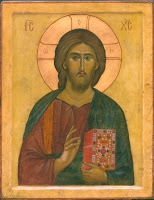
No faith in God can for long survive pure and unalloyed without the support of faith in Christ. "No one knoweth who the Son is, but the Father: and who the Father is, but the Son and to whom the Son will reveal Him" (Luke x. 22). "Now this is eternal life: That they may know thee, the only true God, and Jesus Christ whom thou has sent" (John xvii. 3). Nobody, therefore, can say: "I believe in God, and that is enough religion for me," for the Savior's words brook no evasion: "Whosoever denieth the Son, the same hath not the Father. He that confesseth the Son hath the Father also" (1 John ii. 23).
In Jesus Christ, Son of God made Man, there shone the plentitude of divine revelation. "God, who at sundry times and in divers manners, spoke in times past to the fathers by the prophets last of all, in these days hath spoken to us by His Son" (Heb. i. 1). The sacred books of the Old Testament are exclusively the word of God, and constitute a substantial part of his revelation; they are penetrated by a subdued light, harmonizing with the slow development of revelation, the dawn of the bright day of the redemption. As should be expected in historical and didactic books, they reflect in many particulars the imperfection, the weakness and sinfulness of man. But side by side with innumerable touches of greatness and nobleness, they also record the story of the chosen people, bearers of the Revelation and the Promise, repeatedly straying from God and turning to the world. Eyes not blinded by prejudice or passion will see in this prevarication, as reported by the Biblical history, the luminous splendor of the divine light revealing the saving plan which finally triumphs over every fault and sin. It is precisely in the twilight of this background that one perceives the striking perspective of the divine tutorship of salvation, as it warms, admonishes, strikes, raises and beautifies its elect. Nothing but ignorance and pride could blind one to the treasures hoarded in the Old Testament.
Whoever wishes to see banished from church and school the Biblical history and the wise doctrines of the Old Testament, blasphemes the name of God, blasphemes the Almighty's plan of salvation, and makes limited and narrow human thought the judge of God's designs over the history of the world: he denies his faith in the true Christ, such as He appeared in the flesh, the Christ who took His human nature from a people that was to crucify Him; and he understands nothing of that universal tragedy of the Son of God who to His torturer's sacrilege opposed the divine and priestly sacrifice of His redeeming death, and made the new alliance the goal of the old alliance, its realization and its crown.
The peak of the revelation as reached in the Gospel of Christ is final and permanent. It knows no retouches by human hand; it admits no substitutes or arbitrary alternatives such as certain leaders pretend to draw from the so-called myth of race and blood. Since Christ, the Lord's Anointed, finished the task of Redemption, and by breaking up the reign of sin deserved for us the grace of being the children God, since that day no other name under heaven has been given to men, whereby we must be saved (Acts iv. 12). No man, were every science, power and worldly strength incarnated in him, can lay any other foundation but that which is laid: which is Christ Jesus (1 Cor. iii 11). Should any man dare, in sacrilegious disregard of the essential differences between God and His creature, between the God-man and the children of man, to place a mortal, were he the greatest of all times, by the side of, or over, or against, Christ, he would deserve to be called prophet of nothingness, to whom the terrifying words of Scripture would be applicable: "He that dwelleth in heaven shall laugh at them" (Psalms ii. 3).
From: Encyclical of Pope Pius XI. on the Church and the German Reich, "Mit brennender Sorge", Passion Sunday, March 14, 1937
See also: There is no salvation through anyone else than Jesus Christ
Conclusion:
Muhammad is a prophet of nothingness and does not have eternal life, for he dares, as a mortal, to place himself sacrilegiously over and against Christ the God-man. He denies the Son and therefore does not have nor know the Father, the ONE GODHEAD.
Monday, August 27, 2007
No Other Name Under Heaven has been Given to Men, Whereby We Must be Saved


Jesus Christus als Prüfstein des Gottesglaubens
Kein Gottesglaube wird sich auf die Dauer rein und unverfälscht erhalten, wenn er nicht gestützt wird vom Glauben an Christus. "Niemand kennt den Sohn außer dem Vater, noch kennt jemand den Vater außer dem Sohn und wem es der Sohn offenbaren will (Lk 10,22)." "Das ist das ewige Leben, dass sie Dich erkennen, den allein wahren Gott, und den Du gesandt hast, Jesus Christus (Jo 17,3)." Es darf also niemand sagen: Ich bin gottgläubig, das ist mir Religion genug. Des Heilands Wort hat für Ausflüchte dieser Art keinen Platz. "Wer den Sohn leugnet, hat auch nicht den Vater; wer den Sohn kennt, hat auch den Vater (1 Jo 2,24)." In Jesus Christus, dem menschgewordenen Gottessohn, ist die Fülle der göttlichen Offenbarung erschienen. "Auf vielerlei Art und in verschiedenen Formen hat Gott einst zu den Vätern durch die Propheten gesprochen. In der Fülle der Zeiten hat er zu uns durch den Sohn geredet (Hebr 1, 1-2)." Die Heiligen Bücher des Alten Bundes sind ganz Gottes Wort, ein organischer Teil seiner Offenbarung. Entsprechend liegt auf ihnen noch der Dämmer der Vorbereitungszeit auf den vollen Sonnentag der Erlösung. Wie es bei Geschichts- und Gesetzbüchern nicht anders sein kann, sind sie in manchen Einzelheiten ein Spiegelbild menschlicher Unvollkommenheit, Schwäche und Sünde. Neben unendlich vielem Hohen und Edlen erzählen sie auch von der Veräußerlichung und Verweltlichung, die in dem die Offenbarung und die Verheißung Gottes tragenden alttestamentlichen Bundesvolk immer wieder hervorbrachen. Für jedes nicht durch Vorurteil und Leidenschaft geblendete Auge leuchtet jedoch aus dem menschlichen Versagen, von dem die Biblische Geschichte berichtet, um so strahlender das Gotteslicht der über alle Fehler und Sünden letztlich triumphierenden Heilsführung hervor. Gerade auf solchem, oft düsteren Hintergrund wächst die Heilspädagogik des Ewigen in Perspektiven hinein, die wegweisend, warnend, erschütternd, erhebend und beglückend zugleich sind. Nur Blindheit und Hochmut können ihr Auge vor den heilserzieherischen Schätzen verschließen, die das Alte Testament birgt. Wer die Biblische Geschichte und die Lehrweisheit des Alten Bundes aus Kirche und Schule verbannen will, lästert das Wort Gottes, lästert den Heilsplan des Allmächtigen, macht enges und beschränktes Menschendenken zum Richter über göttliche Geschichtsplanung. Er verneint den Glauben an den wirklichen, im Fleische erschienenen Christus, der die menschliche Natur aus dem Volke annahm, das ihn ans Kreuz schlagen sollte. Er steht verständnislos vor dem Weltdrama des Gottessohnes, welcher der Meintat seiner Kreuziger die hohepriesterliche Gottestat des Erlösertodes entgegensetze und damit den Alten Bund im Neuen Bund seine Erfüllung, sein Ende und seine Überhöhung finden ließ.
Der im Evangelium Jesu Christi erreichte Höhepunkt der Offenbarung ist endgültig, ist verpflichtend für immer. Diese Offenbarung kennt keine Nachträge durch Menschenhand, kennt erst recht keinen Ersatz und keine Ablösung durch die willkürlichen Offenbarungen, die gewisse Wortführerder Gegenwart aus dem sogenannten Mythos von Blut und Rasse herleiten wollen. Seitdem Christus der Gesalbte das Werk der Erlösung vollbracht, die Herrschaft der Sünde gebrochen und uns die Gnade verdient hat, Kinder Gottes zu werden - , seitdem ist kein anderer Name unter dem Himmel den Menschen gegeben, durch den sie selig werden können, als der Name Jesus (vgl Apg 4,12). Kein Mensch -, möge auch alles Wissen, alles Können, alle äußerliche Macht der Erde in ihm verkörpert sein, kann einen anderen Grund legen als den, der in Christus bereits gelegt ist (vgl 1 Kor 3,11). Wer in sakrilegischer Verkennung der zwischen Gott und Geschöpf, zwischen dem Gottmenschen und den Menschenkindern klaffenden Wesensunterschiede irgendeinen Sterblichen, und wäre er der Größte aller Zeiten, neben Christus zu stellen wagt, oder gar über ihn und gegen ihn, der muss sich sagen lassen, dass er ein Wahnprophet ist, auf den das Schriftwort erschütternde Anwendung findet: "Der im Himmel wohnt, lachet ihrer (Ps 2,4)..."
Aus dem Rundschreiben Pius XI. "Mit brennender Sorge" (14. März 1937) an die Bischöfe und die Katholiken des Deutschen Reiches. - MSR (Mensch und Gesellschaft), 211-238
Schlussfolgerung:
Mohammed ist ein Wahnprophet und er hat das ewige Leben nicht; denn er wagt es, sich als Sterblicher sakrilegisch neben, ja sogar über Christus, den Gottmenschen zu stellen. Er leugnet den Sohn, also hat er auch den Vater, hat und kennt er auch den EINEN GOTT nicht!