By Sam Shamoun
Introduction
As the readers may already know, a cursory reading of the Islamic scripture shows that the author of the Quran distorted or was grossly mistaken about the beliefs of Jews and Christians. For example, the author accuses Christians of holding certain theological and christological beliefs that do not correspond to the facts. The Quran erroneously assumes and condemns Christians for believing in three gods consisting of the Father, Mary his wife, and Jesus their offspring. Thus, the Quran erroneously assumes that the implication of Christian beliefs is that God acquired a son through procreation, that God and Mary had sexual relations in order to have Jesus their Son (God forbid such horrendous blasphemy!).
These distortions of biblical teaching and historic Christian beliefs are well known and often commented on by Christian writers, evangelists, apologists, polemicists, scholars etc. They are even admitted by secular writers and sources.
One such writer was the late Christian scholar and Islamicist E.M. Wherry, who commented on the Quran’s distortion of the doctrine of the Holy Trinity in his A Comprehensive Commentary of the Quran. In reference to Sura 4:169[171] Wherry wrote:
Say not... three, "Namely, God, Jesus, Mary. For the Eastern writers mention a sect of Christians which held the Trinity to be composed of those three; but it is allowed that this heresy has been long since extinct (Elmacin, p. 227). The passage, however, is equally levelled against the Holy Trinity, according to the doctrine of the orthodox Christians, who, as Al Baidhawi acknowledges, believe the divine nature to consist of three persons, the Father, the Son, and the Holy Ghost; by the Father, understanding God's essence; by the Son, his knowledge; and by the Holy Ghost, his life." - Sale.
See also Prelim. Disc., p. 64.
The commentators Baidhawi, Jalaluddin, and Yahya agree in interpreting the three to mean "God, Jesus, and Mary," in the relation of Father, Mother, and Son. This misrepresentation of the Scripture doctrine again stamps the Qur'an as a fabrication, and furnishes the evidence of its being such on the ground of its own claims. The history of the Church, as well as the Bible, proves the statement of the text, as interpreted by authoritative commentators, to be false; for even granting that some obscure Christian sect did hold such a doctrine of the Trinity (of which statement we have yet to learn the truth), yet the spirit of Muhammad's inspiration represents it as the faith of the Christians generally. In almost every case where the Qur'an refers to the Christian faith, it is to inveigh against the idea that God has a son. See chap. ix. 31, xix. 31, xliii. 59. (Source)
Christian author and apologist Dr. Robert A. Morey noted that:
The Quran contains many errors about what Christians believe and practice.
One of the most significant is that the Quran misrepresents the Christian doctrine of the Trinity.
Muhammad mistakenly thought that Christians worshiped three gods: the Father, the Mother (Mary), and the Son (Jesus), (Sura 5:73-75,116).
As Richard Bell pointed out:
[Muhammad] never understood the doctrine of the Trinity.
Encyclopedia Britannica states:
[There are] mistaken concepts of the Trinity in the Quran.
… In reality, Christians believe only in one God who is in three persons: the Father, the Son, and the Holy Spirit. They do not believe that Mary is a part of the Trinity.
Even the Concise Dictionary of Islam admits:
In some cases the "material" which forms the substance of Quranic narrative, details of the creeds of Christianity and Judaism for example, does not correspond to those religion’s own understanding of their beliefs. This could be said, for example, of the notion of the Trinity found in the Quran, the story of Satan’s refusal to bow down to Adam, the Docetist view of the crucifixion, all of which can be traced to the dogmas of Gnostic sects, which are heretical in relationship to orthodox Christianity and Judaism. The Trinity "seen" in the Quran is not the Trinity of the Apostles Creed, or of the Nicene Creed. (Morey, The Islamic Invasion: Confronting the World’s Fastest Growing Religion [Harvest House Publishers, Eugene, Oregon 1992], pp. 152-153)
Noted Protestant Church historian and Patristic expert Philip Schaff wrote regarding Muhammad’s mistaken views:
In rude misconception or wilful perversion, Mohammed seems to have understood the Christian doctrine of the trinity to be a trinity of Father, Mary, and Jesus. The Holy Spirit is identified with Gabriel. "God is only one God! Far be it from his glory that he should have a son!" Sura 4, ver. 169; comp. 5, ver. 77. The designation and worship of Mary as "the mother of God" may have occasioned this strange mistake. There was in Arabia in the fourth century a sect of fanatical women called Collyridians (Kollurivde"), who rendered divine worship to Mary. Epiphanius, Haer. 79. (Schaff, History of the Christian Church, Volume IV, Chapter III, "Mohammedanism in its Relation to Christianity", fn. 188; source)
Another Christian Islamicist named Richard Bell stated:
On the other hand, there are considerable differences between the Qur’an and the New Testament. It should be noted, however, that so far as the actual statements of the Qur’an are concerned, the differences are not so great as they are sometimes supposed to be. Modern scholars, Christian and Muslim, tend to read later controversies into the wording of the Qur’an. Thus the rejection of the doctrine that 'God is one of three' [5.73/7] is usually taken to be a denial of the Christian doctrine of the Trinity; yet strictly speaking what is rejected is a doctrine of tritheism which orthodox Christianity also rejects. Similarly the rejection of the fatherhood of God the Father and the sonship of God the Son is strictly speaking a rejection of fatherhood and sonship in a physical sense; and this Christianity would also reject. The Virgin Birth is taught [19.16-33/4], but is interpreted simply as a miracle. The denial that Jesus died on the cross [4.157/6-159/7] is primarily a denial that the crucifixion was a Jewish victory; but, in line with the absence of the conception of sacrifice, it means that the Qur’an never speaks of the atonement or saving work of Jesus. (Bell’s Introduction to the Quran, revised by Montgomery Watt, Chapter 9, "The Doctrines of the Qur’an"; source; underline emphasis ours)
Source: Answering-Islam.org
Tuesday, August 31, 2010
The Quran and the Holy Trinity - Islam’s Mistaken Views of Basic Christian Doctrines


Saturday, August 25, 2007
ALL Power in Heaven and on Earth has been Given to ME
 Matthew 28,18-20:
Sunday, August 19, 2007
This is the Antichrist: Whoever denies the Father and the Son
1 John 2,22-23:
Quis est mendax, nisi is qui negat quoniam Iesus est Christus? Hic est antichristus, qui negat Patrem et Filium. Omnis, qui negat Filium, nec Patrem habet; qui confitetur Filium, et Patrem habet.
¿Quién es el mentiroso sino el que niega que Jesús es el Cristo? Ese es el Anticristo, el que niega al Padre y al Hijo. Todo el que niega al Hijo tampoco posee al Padre. Quien confiesa al Hijo posee también al Padre.
Qui est alors [le] menteur ? C'est celui qui déclare que Jésus n'est pas le Christ. Celui-là est l'Adversaire du Christ [l'Antéchrist] : il rejette à la fois le Père et le Fils. En effet, celui qui rejette le Fils n'a pas non plus le Père ; celui qui reconnaît le Fils a également le Père.
Кто лжец, если не тот, кто отвергает, что Иисус есть Христос? Это антихрист, отвергающий Отца и Сына. Всякий, отвергающий Сына, не имеет и Отца; а исповедующий Сына имеет и Отца.
Wer ist der Lügner - wenn nicht der, der leugnet, dass Jesus der Christus ist? Das ist der Antichrist: wer den Vater und den Sohn leugnet. Wer leugnet, dass Jesus der Sohn ist, hat auch den Vater nicht; wer bekennt, dass er der Sohn ist, hat auch den Vater.
E chi è il bugiardo se non chi dice che Gesù non è il Cristo? Costui è l'anticristo che nega il Padre e il Figlio. Infatti, chiunque rinnega il Figlio non conosce neppure il Padre! Ma chi riconosce il Figlio conosce anche il Padre.
Quem é o mentiroso, senão aquele que nega que Jesus é o Cristo? É o anticristo esse mesmo que nega o Pai e o Filho. Qualquer que nega o Filho, também não tem o Pai; mas aquele que confessa o Filho, tem também o Pai.
Saturday, August 11, 2007
The Athanasian Creed | Symbolum Athanasianum | Афанасьевский символ веры

So there is One Father, not Three Fathers; one Son, not Three Sons; One Holy Ghost, not Three Holy Ghosts. And in this Trinity none is afore or after Other, None is greater or less than Another, but the whole Three Persons are Co-eternal together, and Co-equal. So that in all things, as is aforesaid, the Unity is Trinity, and the Trinity is Unity is to be worshipped. He therefore that will be saved, must thus think of the Trinity.
Furthermore, it is necessary to everlasting Salvation, that he also believe rightly the Incarnation of our Lord Jesus Christ. For the right Faith is, that we believe and confess, that our Lord Jesus Christ, the Son of God, is God and Man.
God, of the substance of the Father, begotten before the worlds; and Man, of the substance of His mother, born into the world. Perfect God and Perfect Man, of a reasonable Soul and human Flesh subsisting. Equal to the Father as touching His Godhead, and inferior to the Father as touching His Manhood. Who, although He be God and Man, yet He is not two, but One Christ. One, not by conversion of the Godhead into Flesh, but by taking of the Manhood into God. One altogether, not by confusion of substance, but by Unity of Person. For as the reasonable soul and flesh is one Man, so God and Man is one Christ. Who suffered for our salvation, descended into Hell, rose again the third day from the dead. He ascended into Heaven, He sitteth on the right hand of the Father, God Almighty, from whence he shall come to judge the quick and the dead. At whose coming all men shall rise again with their bodies, and shall give account for their own works. And they that have done good shall go into life everlasting, and they that have done evil into everlasting fire. This is the Catholic Faith, which except a man believe faithfully and firmly, he cannot be saved.
Quicúmque vult salvus esse, ante ómnia opus est, ut téneat cathólicam fidem: Quam nisi quisqui íntegram inviolatámque serváverit, absque dúbio in ætérnum períbit.
Fides autem cathólica hæc est: ut unum Deum in Trinitátem in unitáte venerémur. Neque confundéntes persónas, neque substántiam separántes. Alia est enim persóna Patris, ália Fílii, ália Spíritus Sancti: Sed Patris, et Fílii, et Spíritus Sancti una est divínitas, æquális glória, coætérna majéstas. Qualis Pater, talis Fílius, talis Spíritus Sanctus. Increátus Pater, increátus Filius, increátus Spíritus Sanctus. Imménsus Pater, imménsus Fílius, imménsus Spíritus Sanctus. ætérnus Pater, ætérnus Fílius, ætérnus Spíritus Sanctus. Et tamen non tres ætérni, sed unus ætérnus. Sicut non tres increáti, nec tres imménsi, sed unus increátus, et unus imménsus. Simíliter omnípotens Pater, omnípotens Fílius, omnípotens Spíritus Sanctus. Et tamen non tres omnipoténtes, sed unus omnípotens. Ita Deus Pater, Deus Fílius, Deus Spíritus Sanctus. Et tamen non tres Dómini: sed unus est Dóminus. Quia, sicut singillátim unamquánque persónam Deum ac Dóminum confitéri christiána veritáte compéllimur: ita tres Deos aut dóminus dícere cathólica religióne prohibémur. Pater a nullo est factus: nec creátus, nec génitus. Fílius a Patre solo est: non factus, nec creátus, sed génitus. Spíritus Sanctus a Patre et Fílio: non factus, nec creátus, nec génitus, sed procédens. Unus ergo Pater, non tres Patres: unus Fílius, non tres Fílii: unus Spíritus Sanctus, non tres Spíritus Sancti. Et in hac Trinitáte nihil prius aut postérius, nihil majus aut minus: sed totæ tres persónæ coaetérnæ sibi sunt et coæquáles. Ita ut per ómnia, sicut iam supra dictum est, et únitas in Trinitáte, et Trínitas in unitáte veneránda sit. Qui vult ergo salvus esse, ita de Trinitáte séntiat. Sed necessárium est ad ætérnam salútem, ut Incarnatiónem quoque Dómini nostri Jesu Christi fidéliter credat. Est ergo fides recta, ut credámus et confiteámur, quia Dóminus noster Jesus Christus, Dei Fílius, Deus et homo est. Deus est ex substántia Patris ante sæcula génitus: et homo est ex substántia matris in sæculu natus. Perfectus Deus, perféctus homo: ex ánima rationále et humana carne subsístens, æquália Patri secúndum divinitátem: minor Patre secúndum humanitátem. Qui, licet Deus sit et homo, non duo tamen, sed unus est Christus. Unus autem non conversióne divinitátis in carnem; sed assumptióne humanitátis in Deum. Unus omníno, non confusióne substántiæ, sed unitáte persónæ. Nam sicut ánima rationális et caro unus est homo: ita Deus et homo unus est Christus. Qui passus est pro salúte nostra: descendit ad inferos: tertia die resurréxit a mórtuis. Ascendit at cælos, sedet ad dexteram Dei Patris omnipoténtis: inde ventúrus est judicáre vivos et mórtuos. Ad cujus advéntum omnes hómines resúrgere habent cum corpóribus suis: et redditúri sunt de factis própriis ratiónem. Et qui bona egérunt, ibunt in vitam aetérnam: qui vero mala, in ignem ætérnum. Hæc est fides cathólica, quam nisi quisque fidéliter firmitérque credíderit, salvus esse non póterit.
Quiconque veut être sauvé doit, avant tout, tenir la foi catholique: s'il ne la garde pas entière et pure, il périra sans aucun doute pour l'éternité.
Voici la foi catholique: nous vénérons un Dieu dans la Trinité et la Trinité dans l'Unité, sans confondre les Personnes ni diviser la substance: autre est en effet la Personne du Père, autre celle du Fils, autre celle du Saint-Esprit; mais une est la divinité du Père, du Fils et du Saint-Esprit, égale la gloire, coéternelle la majesté.
Comme est le Père, tel est le Fils, tel est aussi le Saint-Esprit: incréé est le Père, incréé le Fils, incréé le Saint-Esprit; infini est le Père, infini le Fils, infini le Saint-Esprit; éternel est le Père, éternel le Fils, éternel le Saint-Esprit; et cependant, ils ne sont pas trois éternels, mais un éternel; tout comme ils ne sont pas trois incréés, ni trois infinis, mais un incréé et un infini. De même, tout-puissant est le Père, tout-puissant le Fils, tout-puissant le Saint-Esprit; et cependant ils ne sont pas trois tout-puissants, mais un tout-puissant. Ainsi le Père est Dieu, le Fils est Dieu, le Saint-Esprit est Dieu; et cependant ils ne sont pas trois Dieux, mais un Dieu. Ainsi le Père est Seigneur, le Fils est Seigneur, le Saint-Esprit est Seigneur; et cependant ils ne sont pas trois Seigneurs, mais un Seigneur; car, de même que la vérité chrétienne nous oblige à confesser que chacune des personnes en particulier est Dieu et Seigneur, de même la religion catholique nous interdit de dire qu'il y a trois Dieux ou trois Seigneurs.
Le Père n'a été fait par personne et il n'est ni créé ni engendré; le Fils n'est issu que du Père, il n'est ni fait, ni créé, mais engendré; le Saint-Esprit vient du Père et du Fils, il n'est ni fait, ni créé, ni engendré, mais il procède. Il n'y a donc qu'un Père, non pas trois Pères; un Fils, non pas trois Fils; un Saint-Esprit, non pas trois Saint-Esprit. Et dans cette Trinité il n'est rien qui ne soit avant ou après, rien qui ne soit plus grand ou plus petit, mais les Personnes sont toutes trois également éternelles et semblablement égales. Si bien qu'en tout, comme on l'a déjà dit plus haut, on doit vénérer, et l'Unité dans la Trinité, et la Trinité dans l'Unité. Qui donc veut être sauvé, qu'il croie cela de la Trinité.
Mais il est nécessaire au salut éternel de croire fidèlement aussi en l'incarnation de notre Seigneur Jésus-Christ. C'est donc la foi droite que de croire et de confesser que notre Seigneur Jésus-Christ, Fils de Dieu, est Dieu et homme. Il est Dieu, de la substance du Père, engendré avant les siècles, et il est homme, de la substance de sa mère, né dans le temps; Dieu parfait, homme parfait composé d'une âme raisonnable et de chair humaine, égal au Père selon la divinité, inférieur au Père selon l'humanité. Bien qu'il soit Dieu et homme, il n'y a pas cependant deux Christ, mais un Christ; un, non parce que la divinité a été transformée en la chair, mais parce que l'humanité a été assumée en Dieu; un absolument, non par un mélange de substance, mais par l'unité de la personne. Car, de même que l'âme raisonnable et le corps font un homme, de même Dieu et l'homme font un Christ. Il a souffert pour notre salut, il est descendu aux enfers, le troisième jour il est ressuscité des morts, il est monté aux cieux, il siège à la droite du Père, d'où il viendra juger les vivants et les morts. A sa venue, tous les hommes ressusciteront avec leurs corps et rendront compte de leurs propres actes: ceux qui ont bien agi iront dans la vie éternelle, ceux qui ont mal agi, au feu éternel.
Telle est la foi catholique: si quelqu'un n'y croit pas fidèlement et fermement, il ne pourra être sauvé.
Chiunque voglia salvarsi deve anzitutto possedere la fede cattolica.
Colui che non la conserva integra ed inviolata perirà senza dubbio in eterno.
La fede cattolica è questa: che veneriamo un unico Dio nella Trinità e la Trinità nell'unità.
Senza confondere le persone e senza separare la sostanza.
Una è infatti la persona del Padre, altra quella del Figlio ed altra quella dello Spirito Santo.
Ma Padre, Figlio e Spirito Santo hanno una sola divinità, uguale gloria, coeterna maestà.
Quale è il Padre, tale è il Figlio, tale lo Spirito Santo.
Increato il Padre, increato il Figlio, increato lo Spirito Santo.
Immenso il Padre, immenso il Figlio, immenso lo Spirito Santo.
Eterno il Padre, eterno il Figlio, eterno lo Spirito Santo
E tuttavia non vi sono tre eterni, ma un solo eterno.
Come pure non vi sono tre increati né tre immensi, ma un solo increato e un solo immenso.
Similmente è onnipotente il Padre, onnipotente il Figlio, onnipotente lo Spirito Santo.
Tuttavia non vi sono tre onnipotenti, ma un solo onnipotente.
Il Padre è Dio, il Figlio è Dio, lo Spirito Santo è Dio.
E tuttavia non vi sono tre Dei, ma un solo Dio.
Signore è il Padre, Signore è il Figlio, Signore è lo Spirito Santo.
E tuttavia non vi sono tre Signori, ma un solo Signore.
Poiché come la verità cristiana ci obbliga a confessare che ciascuna persona è singolarmente Dio e Signore, così pure la religione cattolica ci proibisce di parlare di tre Dei o Signori.
Il Padre non è stato fatto da alcuno: né creato, né generato.
Il Figlio è dal solo Padre: non fatto, né creato, ma generato.
Lo Spirito Santo è dal Padre e dal Figlio: non fatto, né creato, né generato, ma da essi procedente.
Vi è dunque un solo Padre, non tre Padri; un solo Figlio, non tre Figli, un solo Spirito Santo, non tre Spiriti Santi.
E in questa Trinità non v'è nulla che sia prima o poi, nulla di maggiore o di minore: ma tutte e tre le persone sono l'una all'altra coeterne e coeguali.
Cosicché in tutto, come già è stato detto, va venerata l'unità nella Trinità e la Trinità nell'unità.
Chi dunque vuole salvarsi, pensi in tal modo della Trinità.
Ma per l'eterna salvezza è necessario credere fedelmente anche all'Incarnazione del Signore nostro Gesù Cristo.
La retta fede vuole, infatti, che crediamo e confessiamo che il Signore nostro Gesù Cristo, Figlio di Dio, è Dio e uomo.
È Dio, perché generato dalla sostanza del Padre fin dall'eternità; è uomo, perché nato nel tempo dalla sostanza della madre.
Perfetto Dio, perfetto uomo: sussistente dall'anima razionale e dalla carne umana.
Uguale al Padre nella divinità, inferiore al Padre nell'umanità.
E tuttavia, benché sia Dio e uomo, non è duplice ma è un solo Cristo.
Uno solo, non per conversione della divinità in carne, ma per assunzione dell'umanità in Dio.
Totalmente uno, non per confusione di sostanze, ma per l'unità della persona.
Come infatti anima razionale e carne sono un solo uomo, così Dio e uomo sono un solo Cristo.
Che patì per la nostra salvezza, discese agli inferi, il terzo giorno è risuscitato dai morti.
E salito al cielo, siede alla destra di Dio Padre onnipotente, e di nuovo verrà a giudicare i vivi e i morti.
Alla sua venuta tutti gli uomini dovranno risorgere nei loro corpi e dovranno rendere conto delle proprie azioni.
Coloro che avranno fatto il bene andranno alla vita eterna: coloro, invece, che avranno fatto il male, nel fuoco eterno.
Questa è la fede cattolica, e non potrà essere salvo se non colui che l'abbraccerà fedelmente e fermamente.
Wer da selig werden will, der muss vor allem den katholischen Glauben festhalten. Jeder, der diesen nicht unversehrt und unverletzt bewahrt, wird ohne Zweifel ewig verloren gehen.
Dies aber ist der katholische Glaube: Wir verehren den einen Gott in der Dreifaltigkeit und die Dreifaltigkeit in der Einheit, ohne Vermischung der Personen und ohne Trennung der Wesenheit. Denn eine andere ist die Person des Vaters, eine andere die des Sohnes; eine andere die des Heiligen Geistes. Aber der Vater und der Sohn und der Heilige Geist haben nur eine Gottheit, die gleiche Herrlichkeit, gleichewige Majestät. Wie der Vater ist, so ist der Sohn und so der Heilige Geist: Ungeschaffen der Vater, ungeschaffen der Sohn, ungeschaffen der Heilige Geist. Unermesslich der Vater, unermesslich der Sohn, unermesslich der Heilige Geist. Ewig der Vater, ewig der Sohn, ewig der Heilige Geist. Und doch sind es nicht drei Ewige, sondern ein Ewiger, wie es auch nicht drei Ungeschaffene oder drei Unermessliche sind, sondern ein Ungeschaffener und ein Unermesslicher. Ebenso ist allmächtig der Vater, allmächtig der Sohn, allmächtig der Heilige Geist. Und doch sind es nicht drei Allmächtige, sondern ein Allmächtiger. So ist der Vater Gott, der Sohn Gott, der Heilige Geist Gott. Und doch sind es nicht drei Götter, sondern ein Gott. So ist der Vater Herr, der Sohn Herr, der Heilige Geist Herr. Und doch sind es nicht drei Herren, sondern ein Herr. Denn wie uns die christliche Wahrheit zwingt, jede Person einzeln für sich als Gott und als Herrn zu bekennen, so verbietet uns der katholische Glaube, von drei Göttern oder Herren zu sprechen. Der Vater ist von niemandem gemacht noch geschaffen noch gezeugt. Der Sohn ist vom Vater allein, nicht gemacht noch geschaffen, aber gezeugt. Der Heilige Geist ist vom Vater und vom Sohn, nicht gemacht noch geschaffen noch gezeugt, sondern hervorgehend. Es ist also ein Vater, nicht drei Väter, ein Sohn, nicht drei Söhne, ein Heiliger Geist, nicht drei Heilige Geister. Und in dieser Dreifaltigkeit ist nichts früher oder später, nichts größer oder kleiner, sondern alle drei Personen sind einander gleichewig und gleichrangig, so dass in allem, wie bereits oben gesagt worden ist, die Dreifaltigkeit in der Einheit und die Einheit in der Dreifaltigkeit zu verehren ist. Wer also selig werden will, soll diese Auffassung von der Dreifaltigkeit haben.
Aber zum ewigen Heil ist es [ferner] nötig, auch an die Fleischwerdung [Menschwerdung] unseres Herrn Jesus Christus aufrichtig zu glauben. Der richtige Glaube ist nun dieser: Wir glauben und bekennen, dass unser Herr Jesus Christus, der Sohn Gottes, zugleich Gott und Mensch ist. Gott ist er aus der Wesenheit des Vaters, vor den Zeiten gezeugt, und Mensch ist er aus der Wesenheit der Mutter, in der Zeit geboren. Vollkommener Gott, vollkommener Mensch, bestehend aus einer vernünftigen Seele und menschlichem Fleisch [Körper]. Dem Vater gleich der Gottheit nach, geringer als der Vater der Menschheit nach. Doch obwohl er Gott und Mensch ist, sind es nicht zwei, sondern ein Christus. Einer aber nicht dadurch, dass die Gottheit in Fleisch verwandelt worden wäre, sondern dadurch dass Gott die Menschheit angenommen hat. Er ist ganz und gar einer nicht durch eine Vermischung der Wesenheit, sondern durch die Einheit der Person. Denn wie vernünftige Seele und Fleisch einen Menschen ergeben, so ergeben Gott und Mensch einen Christus, der gelitten hat um unseres Heils willen, herabgestiegen ist zur Unterwelt, auferstanden ist von den Toten, aufgestiegen ist zum Himmel, sich gesetzt hat zur Rechten des Vaters, von wo er kommen wird, um Lebende und Tote zu richten. Bei seiner Ankunft werden alle Menschen mit ihren Leibern auferstehen und über ihre Taten Rechenschaft ablegen. Und die Gutes getan haben, werden ins ewige Leben eingehen, die Böses [getan haben], in das ewige Feuer.
Dies ist der katholische Glaube. Jeder, der ihn nicht aufrichtig und fest glaubt, kann nicht selig werden.
Всякий, желающий спастись, должен прежде всего иметь кафолическую христианскую веру.
Тот, кто не хранит эту веру в целости и чистоте, несомненно обречен на вечную погибель. Кафолическая же вера заключается в том, что мы поклоняемся единому Богу в Триединстве и Триединству в Едином Божестве, не смешивая Ипостаси и не разделяя Сущность Божества. Ибо одна Ипостась Божества — Отец, другая — Сын, третья же — Дух Святой. Но Божество — Отец, Сын и Святой Дух — едино, слава одинакова, величие вечно. Каков Отец, таков же и Сын, и таков же Дух Святой. Отец не сотворен, Сын не сотворен, и Дух не сотворен. Отец не постижим, Сын не постижим, и Святой Дух не постижим. Отец вечен, Сын вечен, и Святой Дух вечен. И все же они являются не тремя вечными, но единым Вечным. Равно как не существует трех Несотворенных и трех Непостижимых, но один Несотворенный и один Непостижимый. Таким же образом, Отец всемогущ, Сын всемогущ и Святой Дух всемогущ. Но все же не трое Всемогущих, но один Всемогущий. Так же Отец есть Бог, Сын есть Бог и Святой Дух есть Бог. Хотя они являются не тремя Богами, но одним Богом. Точно так же, Отец есть Господь, Сын есть Господь и Святой Дух есть Господь. И все же существуют не три Господа, но один Господь. Ибо подобно тому, как христианская истина побуждает нас признать каждую Ипостась Богом и Господом, так и кафолическая вера запрещает нам говорить, что существует три Бога, или три Господа. Отец является несозданным, несотворенным и нерожденным. Сын происходит только от Отца, Он не создан и не сотворен, но порожден. Святой Дух происходит от Отца и от Сына, Он не создан, не сотворен, не рожден, но исходит. Итак, существует один Отец, а не три Отца, один Сын, а не три Сына, один Святой Дух, а не три Святых Духа. И в этом Триединстве никто не является ни первым, ни последующим, равно как никто не больше и не меньше других, но все три Ипостаси одинаково вечны и равны между собою. И так во всем, как было сказано выше, надлежит поклоняться Единству в Триединстве и Триединству в Единстве. И всякий, кто желает обрести спасение, должен так рассуждать о Троице. Кроме того, для вечного спасения необходимо твердо веровать в воплощение нашего Господа Иисуса Христа. Ибо праведная вера заключается в том, что мы веруем и исповедуем нашего Господа Иисуса Христа Сыном Божиим, Богом и Человеком. Богом от Сути Отца, порожденным прежде всех веков; и Человеком, от естества матери Своей рожденным в должное время. Совершенным Богом и совершенным Человеком, обладающим разумною Душою и человеческим Телом. Равным Отцу по Божественности, и подчиненным Отцу по Своей человеческой сущности. Который, хотя и является Богом и Человеком, при этом является не двумя, но единым Христом. Единым не потому, что человеческая сущность превратилась в Бога. Полностью Единым не потому, что сущности смешались, но по причине единства Ипостаси. Ибо как разумная душа и плоть есть один человек, так же Бог и Человек есть один Христос, Который пострадал ради нашего спасения, сошел в ад, воскрес из мертвых в третий день; Он вознесся на небеса, Он восседает одесную Отца, Бога Всемогущего, откуда Он придет судить живых и мертвых. При Его пришествии все люди вновь воскреснут телесно, и дадут отчет о своих деяниях. И творившие добро войдут в жизнь вечную. Совершавшие же зло идут в вечный огонь. Это — кафолическая вера. Тот, кто искренне и твердо не верует в это, не может обрести спасения.
Todo el que quiera salvarse, ante todo es menester que mantenga la fe Católica; el que no la guarde íntegra e inviolada, sin duda perecerá para siempre.
Ahora bien, la fe católica es que veneremos a un solo Dios en la Trinidad, y a la Trinidad en la unidad; sin confundir las personas ni separar las sustancias. Porque una es la persona del Padre y el Hijo y otra (también) la del Espíritu Santo; pero el Padre y el Hijo y el Espíritu Santo tienen una sola divinidad, gloria igual y coeterna majestad. Cual el Padre, tal el Hijo, increado (también) el Espíritu Santo; increado el Padre, increado el Hijo, increado (también) el Espíritu Santo; inmenso el Padre, inmenso el Hijo, inmenso (también) el Espíritu Santo; eterno el Padre, eterno el Hijo, eterno (también) el Espíritu Santo. Y, sin embargo, no son tres eternos, sino un solo eterno, como no son tres increados ni tres inmensos, sino un solo increado y un solo inmenso. Igualmente, omnipotente el Padre, omnipotente el Hijo, omnipotente (también) el Espíritu Santo; y, sin embargo no son tres omnipotentes, sino un solo omnipotente. Así Dios es el Padre, Dios es el Hijo, Dios es (también) el Espíritu Santo; y, sin embargo, no son tres dioses, sino un solo Dios; Así, Señores el Padre, Señor es el Hijo, Señor (también) el Espíritu Santo; y, sin embargo, no son tres Señores, sino un solo Señor; porque así como por la cristiana verdad somos compelidos a confesar como Dios y Señor a cada persona en particular; así la religión católica nos prohíbe decir tres dioses y señores. El Padre, por nadie fue hecho ni creado ni engendrado. El Hijo fue por solo el Padre, no hecho ni creado, sino engendrado. El Espíritu Santo, del Padre y del Hijo, no fue hecho ni creado, sino que procede.
Hay, consiguientemente, un solo Padre, no tres padres; un solo Hijo, no tres hijos; un solo Espíritu Santo, no tres espíritus santos; y en esta Trinidad, nada es antes ni después, nada mayor o menor, sino que las tres personas son entre sí coeternas y coiguales, de suerte que, como antes se ha dicho, en todo hay que venerar lo mismo la unidad de la Trinidad que la Trinidad en la unidad. El que quiera , pues, salvarse, así ha sentir de la Trinidad.
Pero es necesario para la eterna salvación creer también fielmente en la encarnación de nuestro Señor Jesucristo. Es, pues, la fe recta que creemos y confesamos que nuestro Señor Jesucristo, hijo de Dios, es Dios y hombre. Es Dios engendrado de la sustancia del Padre antes de los siglos, y es hombre nacido de la madre en el siglo: perfecto Dios, perfecto hombre, subsistente de alma racional y de carne humana; igual al Padre según la divinidad, menor que el Padre según la humanidad. Mas aun cuando sea Dios y hombre, no son dos, sino un solo Cristo, y uno solo no por la conversión de la divinidad en la carne, sino por la asunción de la humanidad en Dios; uno absolutamente, no por confusión de la sustancia, sino por la unidad de la persona. Porque a la manera que el alma racional y la carne es un solo hombre; así Dios y el hombre son un solo Cristo. El cual padeció por nuestra salvación, descendió a los infiernos, al tercer día resucitó de entre los muertos, subió a los cielos, está sentado al adiestra de Dios Padre omnipotente, desde allí ha de venir a juzgar a los vivos y a los muertos, y a su venida todos los hombres han de resucitar con sus cuerpos y dar cuenta de sus propios actos, y los que obraron bien, irán a la vida eterna; los que mal, al fuego eterno.
Esta es la fe católica y el que no la creyere fiel y firmemente no podrá salvarse.
Friday, August 10, 2007
God Father and the Holy Spirit Give Their Testimony (Bear Witness) to Jesus' Divine Sonship
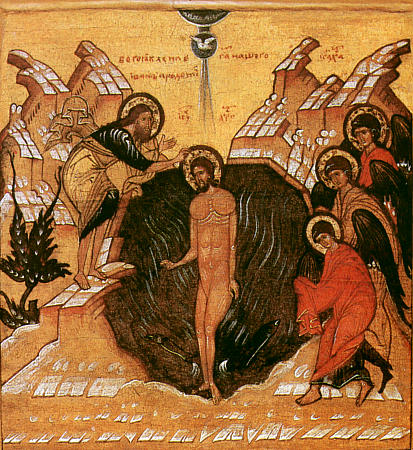
And Jesus being baptized, forthwith came out of the water: and lo, the heavens were opened to him: and he saw the Spirit of God descending as a dove, and coming upon him. And behold a voice from heaven, saying: This is my beloved Son, in whom I am well pleased.
See also: La Théophanie de Notre Seigneur Dieu et Sauveur Jésus Christ
Baptizatus autem Iesus, confestim ascendit de aqua; et ecce aperti sunt ei caeli, et vidit Spiritum Dei descendentem sicut columbam et venientem super se. Et ecce vox de caelis dicens: “Hic est Filius meus dilectus, in quomihi complacui”.
И, крестившись, Иисус тотчас вышел из воды, --и се, отверзлись Ему небеса, и увидел [Иоанн] Духа Божия, Который сходил, как голубь, и ниспускался на Него. И се, глас с небес глаголющий: Сей есть Сын Мой возлюбленный, в Котором Мое благоволение.
Bautizado Jesús, salió luego del agua; y en esto se abrieron los cielos y vio al Espíritu de Dios que bajaba en forma de paloma y venía sobre él. Y una voz que salía de los cielos decía: «Este es mi Hijo amado, en quien me complazco.»
Jesus Christ and God Father and the Holy Ghost = The One Divinity

Jesus saith:
If you had known me, you would without doubt have known my Father also: and from henceforth you shall know him, and you have seen him.
Philip saith to him: Lord, shew us the Father, and it is enough for us.
Jesus saith to him:
Have I been so long a time with you; and have you not known me? Philip, he that seeth me seeth the Father also. How sayest thou, Shew us the Father? Do you not believe, that I am in the Father, and the Father in me? The words that I speak to you, I speak not of myself. But the Father who abideth in me, he doth the works.
Jésus lui répond (à Thomas):
Si vous m’aviez connu, vous auriez aussi connu mon Père et dès à présent vous le connaissez, et vous l’avez vu.
Philippe lui dit: Seigneur, montre-nous le Père, et cela nous suffit.
Jésus lui dit: Il y a si longtemps que je suis avec vous, et tu ne m’as pas connu, Philippe? Celui qui m’a vu, a vu le Père; et comment donc dis-tu: Montre-nous le Père?
Ne crois-tu pas que je suis dans le Père, et que le Père est en moi? Les paroles que je vous dis, je ne les dis pas de moi-même; mais le Père qui demeure en moi, [c’est lui qui] fait les œuvres.